

Parker had had trouble with demolished Parker "75" nibs beeing returned because customers, used to the rougher handling of ball pens, pressed too hard and damaged the nibs. The Parker "180" nib was designed to be rigid enough to withstand a certain amount of pressure.The Parker "180" had a rigid bar on top of the nib to prevent it from bending and the ink feed held the nib firm from the other direction. It wasn't as easy as it sounds. The name Parker "180" was filed by Parker as a trademark already in april 1974 but it wasn't launched until 1977. The Parker "180" fountain pen was also heavily advertised in 1977, together with the old ardenner Parker "75". Ads appeared in the New York and Philadelphia Magazine, View Northwest and the Washingtonian while "75" and Classic ball pens was advertised in Time, Newsweek, Wall Street Journal and Sports Illustrated. Ball pens was clearly bringing home the bacon, and had been doing so since the mid 1960's, but the slim designs and cool nib of the Parker "180" was being noticed and it slowly began to sell surprisingly well. Many finishes were later made in the Parker factory in Meru, France, and especially the laque and patterened metal pens became very popular.
In 1977 the 22K gold electroplated Imperial Fountain pen (a finish with converging lines) cost $40, while the matching Ball pen cost $20. The brushed stainless steel Flighter cost $30, and the matching cap actuated Ball pen was offered for $10.
In 1978 the Floating ball pen was introduced, but it was only referred to as the Imperial, and Flighter GT Floating ball pen and was not advertised as part of the Parker"180" line. These were factory fitted with black or Blue fine points which could be changed to a stylus or super soft tip at the counter. A Parker "180" variant, the Ms Parker (designed by Pucci), was also offered as a Ball pen.
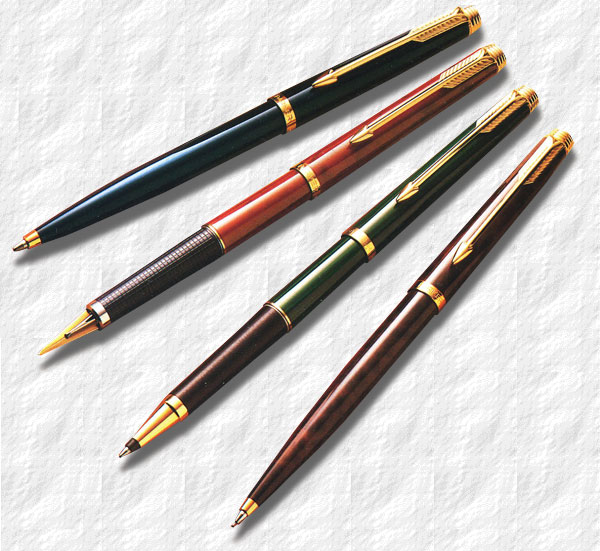
In mid 1979 the Parker "180" was offered in five laquer finishes in pastel colours.
 Yellowish Brown Tortoiseshell
Green Malachite
Jasper Red Quartz
Blue Lapiz Lazulii
Greyish Brown Thuya (or Woodgrain)
In his book "Fountainpens of the world" Andreas Lambrou repeats the colours advertised in France with food references:
Safran (Saffron)
Muscade, (Nutmeg)
Gentiane (Gentian)
Poivre (Pepper)
Olive
In the 1980 catalogue the Parker "180" Flighter cost $50, a substantial price, almost twice as much as only a few years back. The Floating ball pen cost $20, the Ball pen cost $15 and dito for the pencil. The 18k heavy gold electroplated Imperial was offered in the same range but the prices was kept a secret with the dealers being asked to consult the confidential dealer price list (which lists them at $75, $50 and $40 respectively.) The Parker "180" variant Ms Parker, was priced at $45 for the fountain pen and the floating ball pen for $25.
Later, in August of 1980, a laque finish was introduced to the line and a selection of Place Vendôme Parker "180" was introduced, advertised as "an exquisite blend of Parisian charm and craftsmanship. Brilliant patterns ... engraved by old-world craftsmen".
In 1981 Parker advertised the Heritage collection, a limited distribution collection of elite writing instruments. The Heritage Collection comprised of the Parker "75" Presidential, the Gold Parker "50", the Classic Laque and Keepsake and the Parker "180" laque. The Parker "180" was offered in the three solid laque colors of Blue, Red, Green and the brown Thuya. The Fountain pen cost $100, the Roller Ball, Ball pen and Pencil $75, respectively.
The Parker "180" has recieved an unjust reputation of being unwilling writers. This is not true. They perform very well and are excellent writers. They are however very slim and although not specifically made for women, some large-handed writers might find them a tad too slender. The gold nibbed versions are top of the line pens that are very collectible. They were made in both France and UK and also in the US, so there are many variants, prototype and test runs out there, like the bark finish Guilloché and the twisted cable finish Torsade.