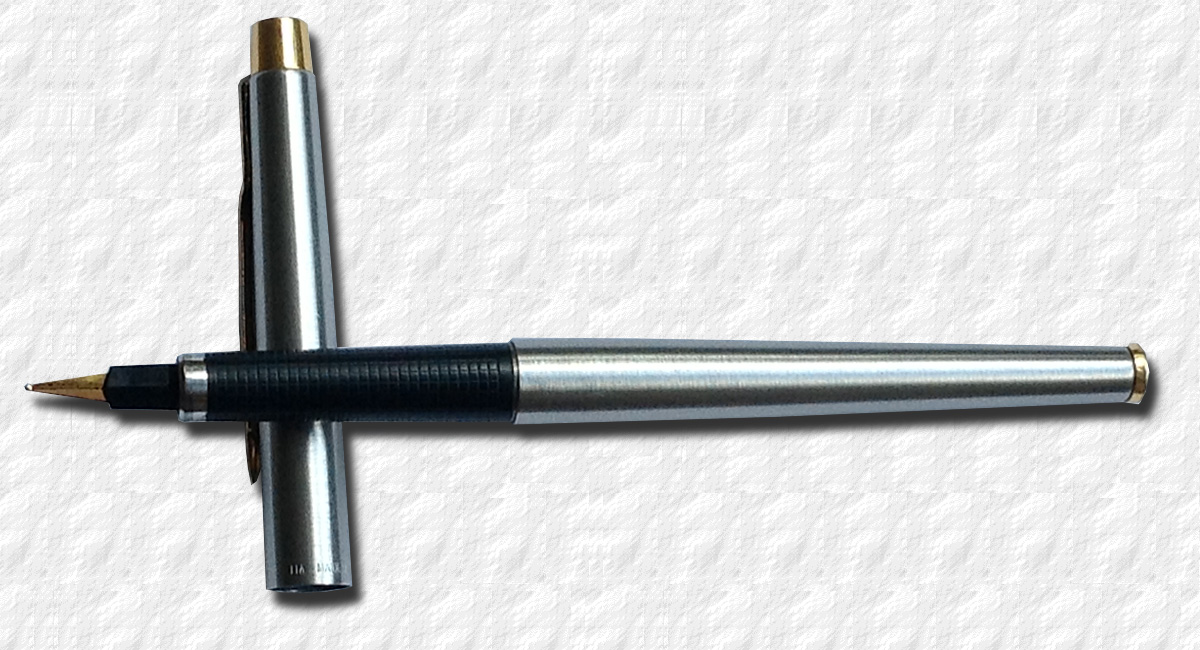
Also: "International Classic"
There are two generations of the Parker Classic pen. The first generation was a ballpoint pen and pencil, introduced in 1967, called the International Classic. It was a slim, very well balanced pen, intended as a sort of a rich man’s Jotter. Ball pens were beginning to be really in vogue and Parker needed a pen that could both capture the high end ball pen market and function as a companion to the top line fountain pens. Parker decided to give the new ball pen a modename of it’s own and there were no fountain pens produced in the International Classic line.
It followed the design of the immensly popular fountain pen Parker 75, including the Sterling silver Cicelé and Vermeil Cicelé; gold plated sterling silver. The clip had a newly designed Parker Arrow clip, with the longitudinal arrow an integral part of the bottom of the ”feathers”, like an elongated Y.
Classic in Sterling silver Cicelé
In 1968, encouraged by the success of the Parker 75 Spanish treasure in 1966, Parker decided to make the Space Pen, an International Classic limited edition pen that had the push button made with metal from Friendship 7, piloted by John Glenn, the first american to orbit the earth in 1962. The pens were made to commemorate the ten-year anniversary of NASA. The metal came from the "Atlas" rocket booster, salvaged in Africa. Only 250 ball-pens were made and these were solely used as gifts for heads of state and high-ranking NASA officials. Needless to say, John Glenn also received a pen.
In 1971 a Flighter (an all stainless steel) version was added to the line. It had chrome trim (CT).
It had been a long tradition with Parker to offer a ladies alternative to their pens and in 1975 the Parker Lady was launched. Ladies pens were usually smaller but the Parker Lady was of the same size and design as the International Classic, save the finish.
In 1977 the Parker Lady was offered in laquered finishes,
a design to become very popular on other models in the mid 1980’s.
In 1978 two new designs were added to the model, the Gold plated Fine Barley design called the Imperial and the Silver plated Insignia, which had a pleasing straight line design that was very distinct. By 1981 the model name Parker Lady was dropped. In 1982 a Flighter with GPT was introduced as a ballpoint and pencil and from 1983 on, the pens were advertised simply as Parker Classic, dropping the "International".
In 1986 Parker saw fit to incorporate a Fountain Pen to the Classic line. This followed the demise of the very slim Parker 180. The Parker 180 had an innovative, totally flat and very pointed nib that boasted double writeability in the ads, a function that actually had worked even back on the Vacumatics and Parker 51. The triangular nib was now ”rescued” over to the new Classic fountain pen, although the double writeability actually had been abandoned on the Parker 180 in 1983, when the solid
Click on the image for a larger view!
Image © and courtesy of Erik Drijfhout
Parker Classic GT fountain pen.
Flighter GT and Flighter CT ballpens.
14k gold nib was replaced with a gold plated stainless steel nib. This was also the nib design on the Classic. The Classic was about 135 mm long when closed and 9.5 mm wide. It had a steel ring at the end of the section.
The first Classic fountain pen designs in 1986 were:

Gold Plated Millereaies design
Matte black epoxy coated
Stainless steel (Flighter)
Laque Sapphire
Laque Jade
Laque Tourmaline
Later in
1986 the Laque Thuya, a bandless wood grain model, was offered
In
1988 the Laque finishes in Sapphire, Jade and Tourmaline were discontinued:
Gold Plated Millereaies design
Matte black epoxy coated
Stainless steel (Flighter)
Laque Thuya
Matte Navy (not offered as a fountain pen)
Matte Plum (not offered as a fountain pen)
In 1989 a Matte black 22 k goldplated Classic Desk pen was added to the line.
By
1990 the Classic range was offered in:
Gold Plated Milleraies ( a thousand lines in French)
Gold Plated Grain d’Orange (barley grain)
Gold Plated Perlé (straight lines with dots)
Laque Thuya
Matte black
Flighter
Sterling silver Cicelé (not offered as a fountain pen)
By
1993 the Gold Plated Grain d’Orange and Gold Plated Perlé had been discontinued and the new Parker gold plating method, referred to as the Diamonite, an alloy of 50% gold and 50% titanium was offered on the trim of the Laquered Thuya, Sterling Silver, Flighter GT and Matte black models.
The Classic in
1993:
Gold Plated Milleraies
Laque Thuya
Matte black
Flighter GT
Flighter CT (not offered as a fountain pen)
Sterling silver Cicelé (not offered as a fountain pen)
The Matte Black Classic
In 1994 only the Matte black and the Desk pen was offered as fountain pens.
The Classic line was not featured in the 1995 product catalogue, nor the 1998.
According to Jim Mahmoulian the Classic surfaced again as a ballpoint and pencils in the 2001 catalogue. In 2003 it was gone again. This could however be discreapancies between the US and European markets.
Read more about the Classic line at Jim Mahmoulians great site http://www.penhero.com
Read more about the Space pen at Lih Tah Wongs great site http://www.parker75.com
©
1995-2019 Tony Fischier and The Parker Pen Company®/Sanford Ecriture.
This page is in no way sponsored by or created by the
Parker
Pen Company®. All opinions, views, and thoughts expressed
herein are expressly the authors, and in no way reflect the opinions,
views, or thoughts of the
Parker Pen Company®/Sanford Ecriture.
All logos and/or images on these pages are
© Copyright of
Parker Pen Company®Sanford Ecritureunless otherwise stated and is reprinted by kind permission. If You feel that Your copyright has been violated please contact the
WEBMASTER.
Everything on this website is
copyrighted by law and can not be
used without written permission from the author,
Tony Fischier. You may however use the information as reference material and
although it is forbidden to make digital copies or reproductions
it may be physically printed for
personal use, which does not include use on other web pages or in advertising.
You may however quote
parts of the content of this website, digitally or physically,
providing that the source and author is clearly stated, together
with the copyright information. In the US referred to as
Fair use. If you use any information on this site, add a link.
Feel free to
donate a small sum through
Paypal to help this site to stay online.
Acknowledgements.