

"School pens"
1924–1933
HISTORY
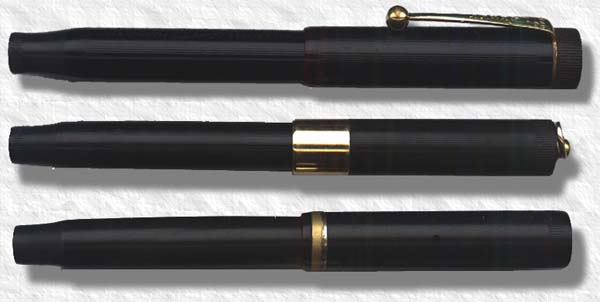
Top: A 1925 Parker X in plastic, sans cap band with clip. Middle: A 1926 Parker Gold and Black, Lady style in plastic with a broad cap band and a ring top. Bottom: A 1924 black hard rubber Parker "DQ", Junior with one cap band, no clip.
At this time Parker was threatened by Sheaffer who had begun to use the new material plastic in their production, allowing for more sturdy pens in other colours than red. To make things even more troublesome Sheaffer had also secured the rights to the new material with the largest manufacturers. Even so Parker managed to sign a contract with the plastic manufacturer DuPont and what better way to try out a new material than in a pen line that was cheap and also was not advertised. Thus the first of the Parker plastic pens, made from a material called pyroxylin (later referred to as "permanite"), was indeed the Black Line pens, marked with an X, Parker X. These of course are very collectible, especially the Senior, but can still be found at very reasonable prices in the collector community.
The 1929 Parker catalogue depicts the Black and Gold pens with either two cap bands (following the 1928 Duofold redesign) or no cap bands. They cost $3.50 and $2.75, respectively. They had now lost the lenghtwise stripes, but still had the Lucky Curve banner. This changed in the 1930 catalogue, when the imprint read
Geo S Parker Pen made in USA
Patented
They were also renamed  "Raven Black and Gold". Hence the collectors today usually refer to the lined black and gold pens as the "DQ" and the smooth ones as the "Raven". The Ravens were also streamlined, again following the Duofold design.
In 1932 the Black and Gold pens was yet again redesigned. They again sported the "DQ" lines and all had a thin gold band, replacing the earlier models.
The year 1934 saw the redesign of the complete line of Parker pens, phasing out the Duofolds, making way for the next era of great pen making, the Vacumatic. The Black and Gold pens were also
discontinued and two other models were introduced to capture the low-end markets. The Parkette and the Challenger. Both models featured in other colours than black.