

For obvious reasons it's virtually impossible to list all the pens made by Parker from this period. Partly because there was a constant tinkering going on and since all pens were more or less hand made there are discrepancies, prototypes and repairs made with different spares. Partly because Parker also made alot of pens by order. If You wanted a pen with a gold band engraved with that special flower, Parker would most probably have accomodated You. I will however try to list as many catalogued models as possible and at the same time tell the early story of the production advances of the Parker Pen Company in th earliest days, before the Duofold.
Geo. S. Parker was born in 1863 and patented his first pen design when he was 25 years old.
The main problem with fountain pens is that they are essential a mechanism to provide a controlled leak. Parker soon identified that the main problem was in the design of the ink-feed. In this his first patent he tried a feed that had a plug at the end, which forced the ink to run through a small hole which was the beginning of the ink channel.
Three months later he patented a developed priming-finger with a slit in it. By 1891 he had rejected the plug-idea and instead designed a feed that protruded inside the barrel, this to prevent a blob when the ink level in the pen was low. It also had a new improved over-underfeed.
Constantly experimenting and improving George Parker again in 1893 patented a new kind of bent feed, almost like an old style clothes pin with one prong curiously bent. George Parker explains:
"One or both prongs of the divided rear end of the bar should be bent away to present a more available surface for the outflowing ink."
This suggests that the appearent likeness with the later Lucky Curve feed was only circumstantial. Nevertheless there are of course other similarities.
The famous  Lucky Curve feed was patented in 1894 and this was he first single idea that began to get things moving for Parker.
Already from the beginning Parker realised the impact this invention could have and he decided to advertise this new pen feature, even though it was a part that was actually hidden inside the pen.
The first 1888 Parker pens were in fact John Holland pens that had been tinkered with by George S Parker. The only item that survived and might — with a little imagination — be a John Holland Parker pen, is in the L. Michael Fultz—Gregory H. Sachs collection. It was purchased by Mr. Fultz in a flea market just outside Janesville. It was made around 1885-1890 and has file marks on the ink feed, which bears a striking resemblence to the first patent filed by George Parker.
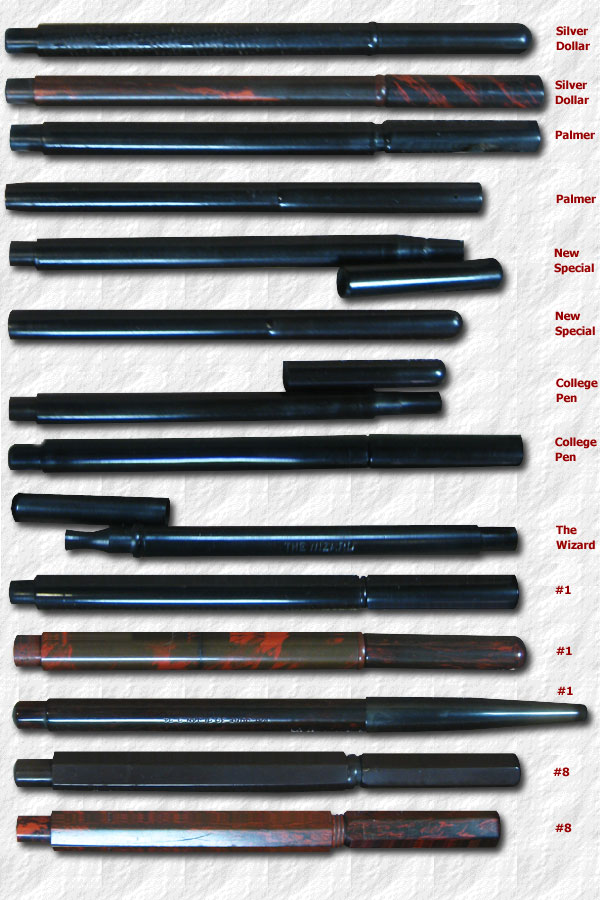
The first true Parker pens was very simple and plain Black hard rubber pens with straight caps with rounded ends. The cheapest version was selling for $1 and was later referred to as the Silver Dollar pen. The Special sold for $1.50 and the Standard, which evolved into the #1, sold for $2. Top of the line was the Hexagon pen, which sold for $3. The latter was also advertised in 1894. Since few pens of this time had clips, pens tended to roll off the desks and the hexagon pens were very popular. It was advertised with "The Wonderful Curved Tubular Feeder". The name Lucky Curve was not yet being used. The Hexagon later got the catalogue number #8.
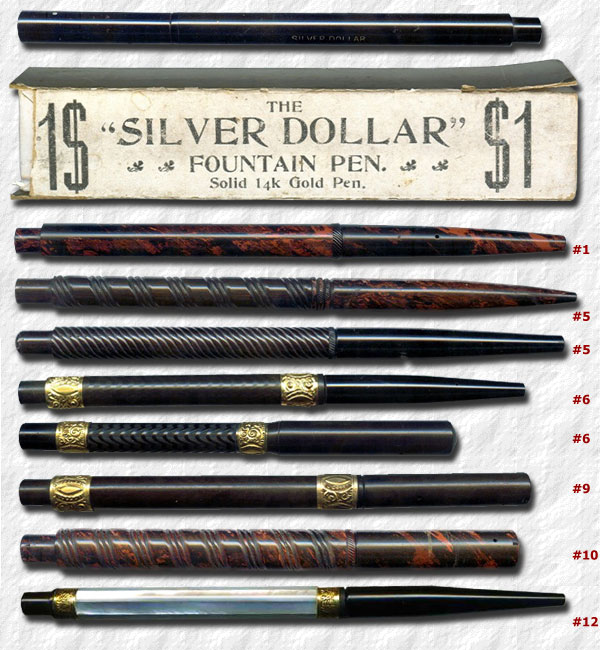
By 1896 Parker had organised his pen range and they were offered with a number of attractive designs. It's hard to imagine the logic behind the numbering system, since some of the gaps were not filled until a decade later, and some numbers again were never offered for sale at all: #4, #7 and #13 #19.
Well #13 might be understandable.
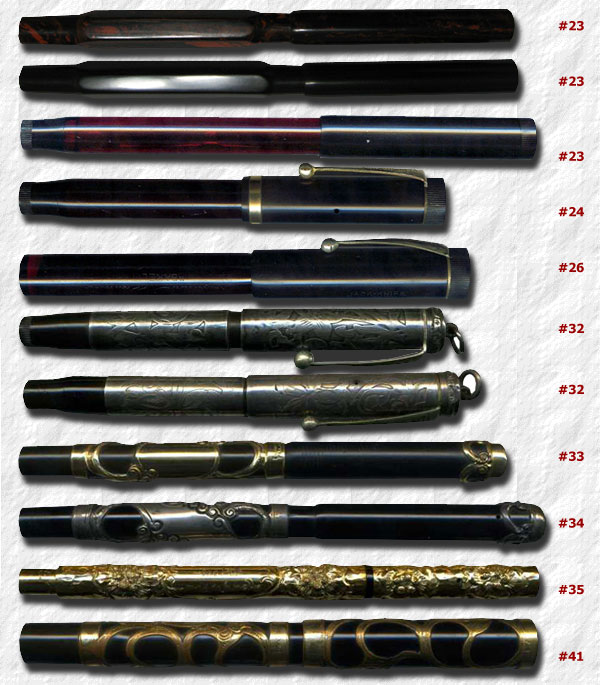
#1 Was the old Standard. It was to remain for a long time in the Parker catalogues, it was a plain Raven black pen in BHR or Red and Black mottled finish.
#3 was of a similar design but sported a chased barrel.
#5 had a spiral body in Black or Mottled with a tapered cap.
#6 was a smaller, ladies sized pen with a twisted design and two ornamented gold bands featuring a tapered cap.
#8 Hexagon pen in Black or Mottled with a tapered cap.
#9 had a wavy chased body and two ornamented gold rings with a black cap.
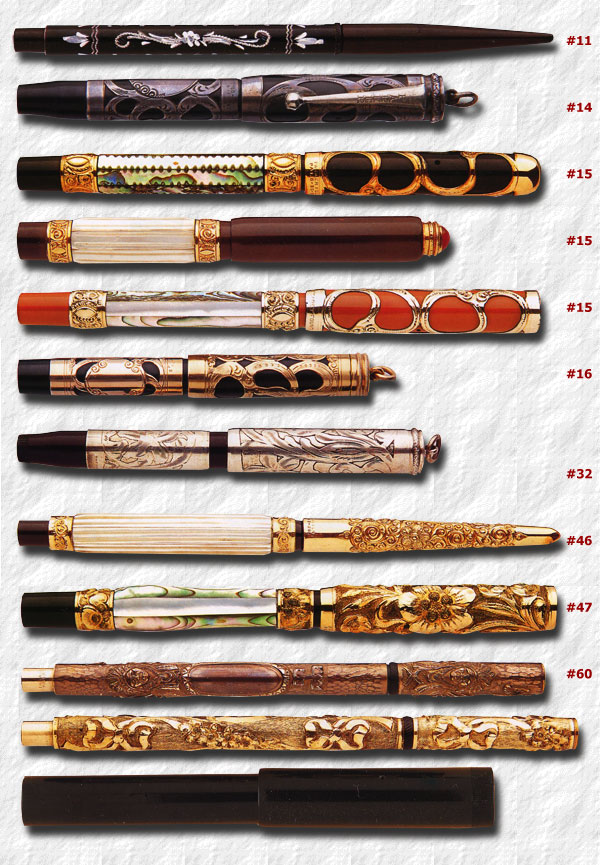
#11 Featured a cable chased gold or silver overlay with a black, tapered cap.
#12 Full Pearl, was a very attractive pen with a mother of pearl body held down by two ornamented gold rings, and a black, tapered cap.
#20 was a plain underfeed pen in Raven Black or Mottled in Red and Black.
#24 and #25 were of the same design, only larger.
The Silver Dollar a plain, black hard rubber pen, also referred to as the Palmer pen, there are also examples of mottled and chased pens. Although cheap, the pen had a 14k nib.
The Special, a plain, black hard rubber pen. Most of these first pens had three stepped rope chased rings separating the body and gripping section. 14k nib.
By 1897 the #3 was offered in two sizes, regular and ladies. The ladies pen sported three stars on the body and had a tapered cap. As did the Regular but this had a chased body with lines running diagonally. A third version was chased in a diagonal pattern.
#5 also came in two designs, the previous Spiral and also an attractive diagonal Twist band version. Both pens could be furnished in Black or Mottled.
Also the #6 model was enhanced with a regular size version of the ladies pen with twisted design, two gold bands and tapered cap.
The #8 Hexagon remained unchanged.
#9 now also came in two finishes, the Wavy and a new zig zag pattern over a body of rope chase.
A new addition was the #10. Similar to the #5 but with rope chased diagonal bands on a Black or Mottled body.
Also new was the fantastic #11 in etched aluminium (aluminum in the US). Aluminium was considered a precious metal at this time. It had a black body with vines of metallic leaves and a tapered cap. The gold or Silver overlay versions was also offered.
#12 Full Pearl remained as did the
#20,
#24 and #25 remained the same.
Jointless pen, also known as the Spring lock feed. It was a Lucky Curve pen that encapsulated the parts inside the barrel and there simply were no way it could leak through any joints or threadings. It also had a new kind of cap that was quite a lot stronger (Parker boasted five times) than the caps made by other pen manufacturers. It was so sturdy that the US Government purched it in large numbers. The Jointless was the first Parker to be advertised outside the US, in the UK. The pen had one disadvantage though. Since the barrel was in one piece, the pen had to be filled by first pulling out the nib and ink feed, and that could not be done without gripping the same. So even if writing was clean, refilling the pen was not.Shorthand pen that was offered for $4. It had an extremely short nib with slits on each sides of the main slit of the nib to provide ink for very fast writing. It was used by a man with the unfortunate name of Dement when he broke the world's record in shorthand writing in Chicago in 1899. Mr Isaac S. Dement wrote over 400 words a minute and he wrote a letter to Parker (presumably very fast):At the end of the century most pens had been overfeed fillers, having an ink feed protruding above the nib leading the ink to the split writing point. By this time it was also clear that the highly acidious ink was murder on the metal nibs. The only metal that sufficiently could handle the acid was gold. For obvious reasons the gold nibbed pens were more expensive, which also lead to them being more of a status symbol. Hence there was a pronounced customer wish to show as much of the nib as possible and this had the affect that everyone wanted pens with underfeeds. George Parker, who had proven before that he had an ear to the ground, immediately began to offer pens with Lucky Curve underfeeds. Other manufacturers who didn't comply to the customer's wish promptly went out of business.
In 1900 the cap was slightly re-designed and now sported a taper inside the cap to make the cap fit more securely. The cheap Special pen was now offered as an underfeed and was renamed the New Special. The Parker Pen company now also sold their own ink. The Shorthand pen was now also referred to as the Bookkeepers pen. The Jointless #026 was introduced as a "regular Goliah. It might be too large for You." As a gimmick it was seldom depicted in the catalogues "not enough printing place". A new Jointless #021 was also introduced in November with two ornamented cap bands. It was based on the #020.
The non-jointless #18, #20, #23, #24 and #25 had lost the somewhat awkward elongated blind cap and instead sported striped sections to provide a better grip. In the UK the Bulldog Special was introduced.
Parker had been offering expensive pens with gold or silver finishes since 1893 but in 1900 the first completely gold covered Parker pen was officially introduced, the #30. It cost a staggering $10.
In 1901 the Jointless pens were offered with an optional manifold nib. These very hard nibs that could handle carbon paper, very similar to the thick nibs later used on the Duofolds. There was also ladies sized version offered for the #020 while some of the old style overfeed pens were offered at a reduction, the #1, #2, #3, #5, #8 and of course the New Special and the Silver Dollar/Palmer Pen.
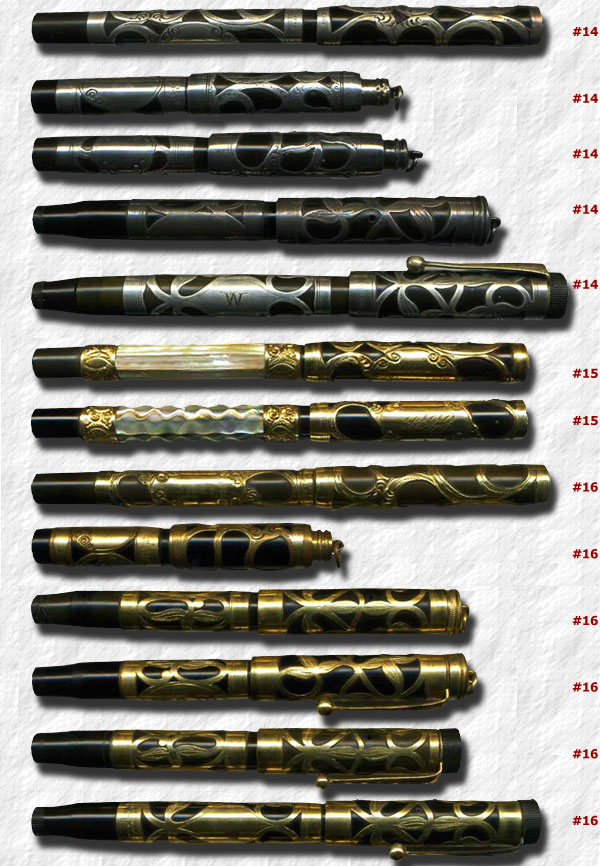
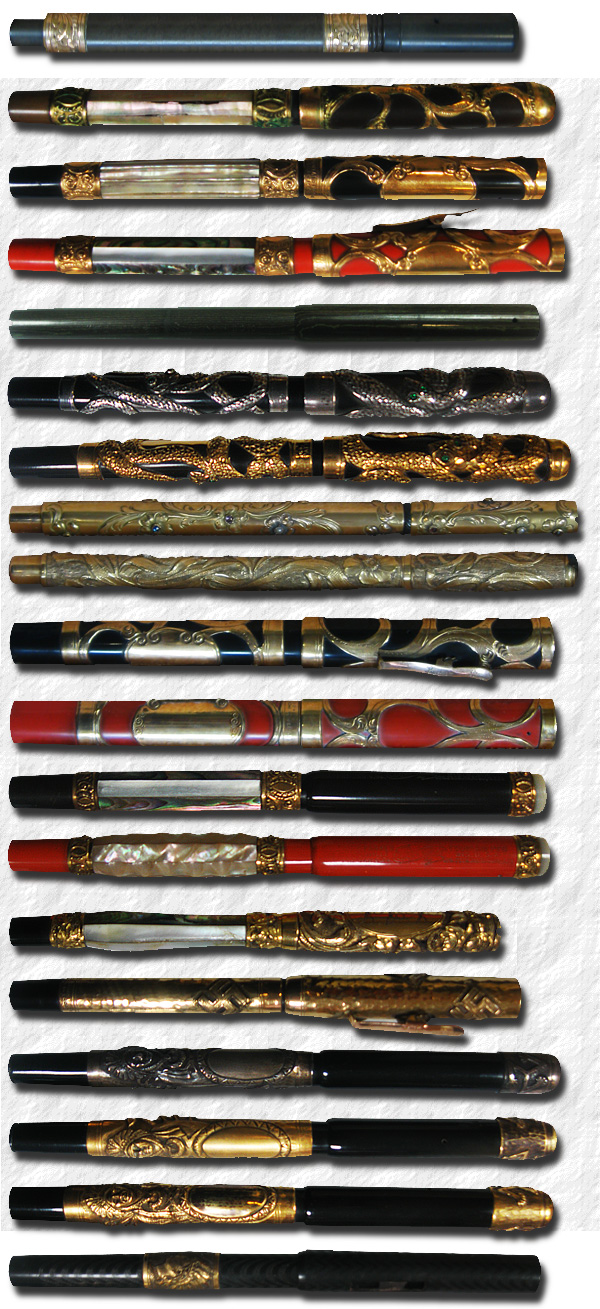
The High class #30 pen was followed in 1902 by the #14 and #16, Parker's first, and destined to become the best selling, filigree pens. They were offered either in Sterling Silver (#14) or solid 18k gold plate (#16). The Silver pen was offered for $5 while the Gold plate cost $6. There was also a Sterling Silver version of the #30 offered at $8.
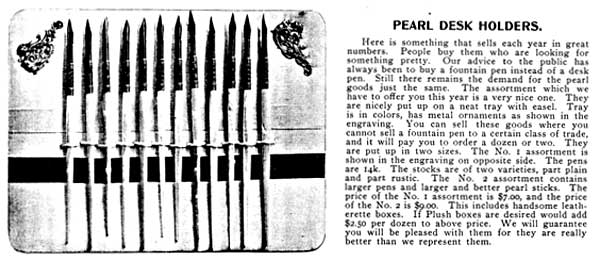
 dip-pens. They came in two sizes and was made in mother of pearl bodies with silver fittings.
 In 1904 The first school pen, aimed specifically at school children, was introduced under the name Mercur. It cost $6 for a dozen, which was the smallest amount sold. It seems it was not a success, because it was not mentioned in the 1905 catalogue. Also in 1904 George Parker sent a company employee named John Guellner to Germany to seach for new ideas for pen-making. He came back with a substance called galalith, which means something like Milk Stone in Greek. Goellner was an exile Serb who had been thrown out of the country by king Peter. George Parker reminicens:
"John worked in the office, spoke no English, studied like a trooper and eventually became a very valuable man to us."

Galalith pens were prone to extreme discolouration and would swell and shrink rather uncontrollably. Parker had made and sold "a number" of galalith pens, but this was during the eyedropper era and there was still no protective ink sacs inside the pens. The production was halted. Later galalith was used as decorative cap ornaments and clip screws and even later, in 1916, Parker re-introduced them as button-fillers under the name Ivorine.In 1905 a screw joint version of the #021 was introduced as the #21. It was a plain barrelled pen with two ornamented gold bands. Also a chased model of the #23 was introduced, denoted by the ½, following the model number, #23 ½. Hence a #23 was a plain black hard rubber pen with a screw joint, a 023 was a Jointless pen and a #23 ½ was a chased black hard rubber pen. These chased pens were also the first Parker pens to have the famous Lucky Curve banner engraved on the body.
The #24 Falcon screw joint pen was also introduced, it had special nib with a broad neck and a horseshoe-shaped depression for increased rigidity. Four types of nibs were offered. Otherwise it was identical to the #24 except that the Falcon also had the Lucky Curve banner engraved. Another new addition was the #28, a huge pen with a number 8 nib, priced at $7. #1 now also featured the Lucky Curve banner.
In September of 1905 the first mechanically filled Parker pen was introduced. Usually referred to by collectors as the Click-filler. In the beginning of the century several pen companies had deveoped their own so called "self fillers". They were not in fact pens which filled themselves, like the much later Parker "61", but they were pens that had some sort of mechanism which allowed the pen to be filled without using an eyedropper. Parker had patented a cruder version of this self filler already in 1904, which was rather similar to the Conklin Crescent filler. George Parker had contacted an inventor of agricultural machines with the Janesville Machine Company and he worked out the first Parker Self Filler. It had a semi-circular plate attached to a metal bar running the lenght of the body inside.
In 1906 all the plain barrelled pens was now offered in a chased version with the Lucky Curve banner, and this year also saw the introduction of the perhaps most legendary Parker pen, the Snake. #37 was the Sterling Silver version and #38 was the gold version. The snakes had green rhinestones for eyes. The Silver snake cost $8 and the Gold Snake $10.
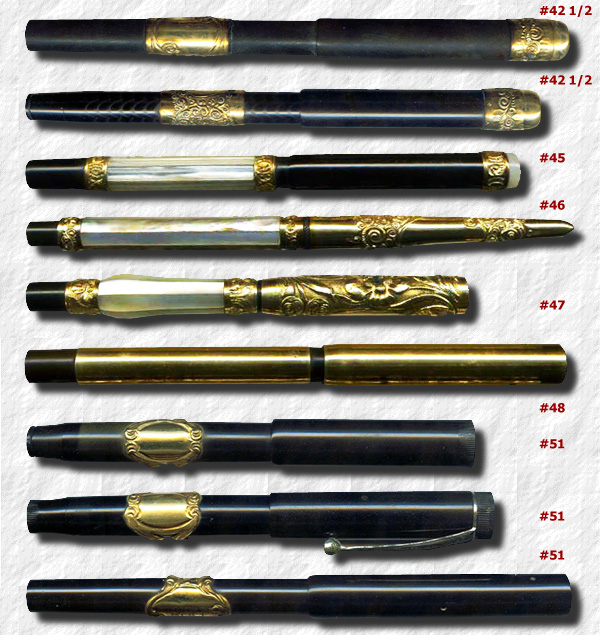
Emblem pens. Parker would sell it and sculpt any club, company or society logo on the solid gold cap band for $12. These were in fact the first pens made with company logos (today Parker boasts 60 000 company logos in their database). George Parker wrote:A new high-end pen was introduced in 1907, the #42 ½. It was a beutiful pen with a chased body and with a very broad engraved gold band around the body with a large name plate in the middle. It also had a heavy gold crown on the cap. It was moderately priced at $4.50.
 Bookkeeper's Special. It was a very long pen with nibs and caps at both ends, one for black ink and one for red ink. The red ink barrel was made in mottled red and black while the black ink barrel was in black. They could also be taken apart to be used as two separate pens. It was offerd for $6.
In 1908 Parker began offering a new kind of spring actuated clip that was riveted to the cap, it was referred to as the Cap fast clip. Modern day collectors usually refer to it as the "VV-clip". It was patented in 1907 by Levi D. Van Valkenburg.
Also in 1908 the #45 was introduced at $6.50. It was an immensly attracctive design of corrugated mother of pearl slabs, held down by two ornamented gold rings. It also had a cap crown in gold and mother of pearl. There was also a version offered with abalone instead of mother of pearl, with a light green crown stone.
Red Giant. It is described in a late 1908 company newsletter: Dollar pen, it still didn't have the Lucky Curve feed. Also in 1909 the Jack Knife cap was introduced. Parker had been working on a new kind of screw-on cap that would prevent ink leakage. It had an inner cap that fit snug when the pen was inserted, so that ink didn't leak out into the outer cap. The application was filed this year but it wasn't patented until 1912. George Parker writes in a July 1909 company newsletter: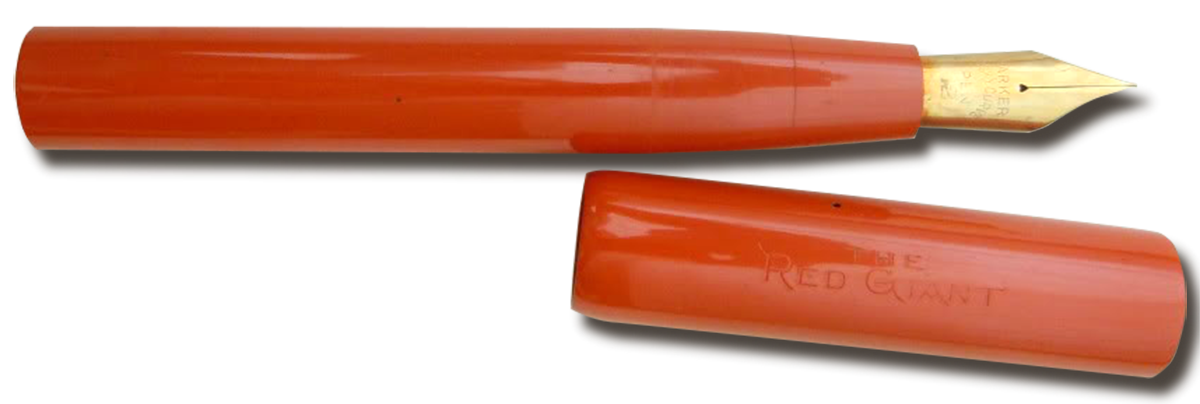 College pen was offered in the models #20 ½, a chased pen with the Lucky Curve banner. A coloured crown was 10c extra, two colours was 25 cents extra. The second model was the #21 ½. A chased pen with two ornamented gold bands and the Lucky Curve banner cost $3.50. The third model was the #24 self filler was also offered at $4 plus 10 cents as a College pen.Pregnant Parker. In my opinion one of the most beautiful pens ever made. I wish I could afford one :-)
In January of 1910 George Parker writes:
"The Jack Knife pen is the new thing in fountain pens. The extraordinary demand for this pen, was so unexpected, so phenomenal that it proved to be the selling phenomenon of the year."
The Jack Knife sold so well that Parker had to hire more workers to fill the demand.
A new style slip on ball clip was offered in different sizes while the VV-clip was still being offered. The Jointless pens were being phased out but could be bought by special order. The Dollar pen was finally discontinued.
The extensive range of Parker pens in 1910:
The Emblem pen
The College pen: #20 ½ chased, #21 ½ chased with two gold bands, #24 self filler
The Shorthand pen in two sizes
Jack Knife ladies ring top turban top sterling silver mountings or gold mountings or plain or with a gold band.

#52 Swastika in sterling hammered silver cost $12 and the #53 Swastika was offered in 18k gold overlay for $15.1911 didn't see quite as much change as the year before, but one great addition to the Parker line was the Awanyu "Aztek" pen. George Parker tells in a 1911 Sidetalk how he went to Santa Fe in New Mexico and visited the Archeological institute of America. There he found "the most wonderful collection of Indian and Aztek relics" he ever saw. In one room he saw "a most peculiar design of early Aztek designing". He was told that it was the Aztek emblem of mystic power, the preserver of life and the guardian of spring an streams. Parker proptly secured the rights to copy the design. Back home in the US he had a silver smith reproduce the pattern at it was used on the new pen.
In 1907 Parker had patented the level lock clip that didn't protrude but fitted flush with the cap until the pen was inserted into the cap, forcing the clip to grip the edge of the pocket tight. It hadn't been advertised earlier but now it was offered as the "clip that disappears." Since it couldn't easily be fitted without making a hole in the cap, it had to be factory fitted. Retail price was 15 cents.
In 1912 a plain barrelled pen with 14k gold overlay was introduced as #48 for $8. As was the #49 of a similar design but engraved with deep lines. It was offered in two sizes and cost $10. Later the same year Jack knife versions of the #48 and #49 was introduced for $8 and $10 respectively. #55 and #56 was of the same Jack Knife designs but finished in Sterling Silver. Also a De Luxe version of the #54 Forget-me-not was introduced as the #39. It had stones and pearls set in the center of the flowers and cost $20.
There was also a line of full length (extra long) Jack Knife turban top pens introduced, according to Parker by popular demand. they were offered in the sizes #20, #23½, #24 and #25.
George Parker also got his Jack Knife patent approved in June of 1912, it had been filed already back in 1909.
I 1913 ring top pens was introduced, they were ment to be hung from a string or a band around the neck and was very popular among women, who perhaps had a harder time finding their pen in their handbags and usually didn't have pockets on their dresses.
Several Jack Knife models were offered with the ring top:
#20 Jack Knife regular length or long barrel, ring top, $2.75
#20 ½ Chased Jack Knife regular length or long barrel, ring top, $2.75
#23 Jack Knife regular length, ring top, $3.25
#23 ½ Chased Jack Knife regular length or long barrel, ring top, $3.25
#25 Jack Knife regular length or long barrel, ring top, $5.25
#25 ½ Chased Jack Knife regular length or long barrel, ring top, $5.25
Parker was so overwhelmed that he couldn't handle all the business and he had to increase the manufacturing facilities to eventually fill the orders.
The standard setup of Screw joint pens was offered with the new Button filler. A hew size, #18, with or without a level lock clip was offered for $2 and $2.25, respectively. Also a chased #18 ½ version was offered. The #18 did not feature the Button filler. This was offered only for the models #20, #20 ½, #23, #23 ½, #24, #24 ½, #25 and #25 ½, but not for the #28.
Some high end-pens, like the #15 and the #37/38 were slightly re-designed and now sported a flatter cap. There were also mottled and red hard rubber versions offered for some of the high-end pens, noteably the #15 and #16. These items are very rare and much sought for by collectors.
In 1914 the Red Giant got a companion, the Black Giant. It was virtually identical, but offered in black hard rubber. Another novelty was also introduced, the Transparent bakelite pens. Parker had begun making a few bakelite pens as Demonstrators for the salesmen, but a lot of customers wanted to buy the Demonstrator.
Also a Jack Knife version of the #45 corrugated Mother of pearl, with a white or coloured crown stone was now offered for $6.50. Another new addition was the #61 with the barrel, cap and section in plain 18k gold overlay, it cost $12.
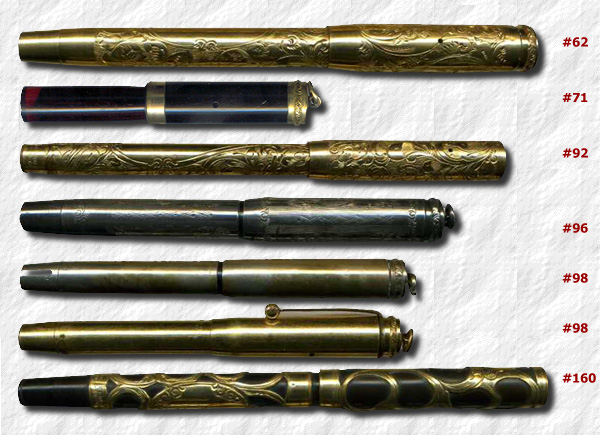
Also the new #62 had the barrel, cap and section in 18k gold overlay but it had elaborate engravings of leaves and vines, with a name plate, $14, and #63 was a gold filled pen with a little wreath in the center of the barrel as a name plate, and lines around the ends of the barrel and the cap. $12.50 while #64 was a pen with the barrel, cap and section in gold overlay with a checkered design, except the ends of the cap and barrel which were plain with lines around and a name plate on the barrel, it cost $13.
Also introduced was the #140 and #160, in the same design as the #14 and #16 but larger and with a size #4 nib. The #140 was in Sterling Silver and cost $6.50 and the Gold filigree #160 cost $7.50.
Within a year from the introduction 80% of Parkers business came from the Button Fillers, so in 1915 Parker decided to change the whole organisation to be able to handle the fantastic demand.
This meant discontinuing practically the whole Parker line, including the high end overlays and filigrees. Left were only the #6, #9, #14 regular or Baby, #16 regular or Baby, #21 ½ with the engraved gold bands, #32, #33, #34 #42 ½, #48, #49, #50, #50 ½, #51 in Sterling or gold, #58 Awanyu "Aztek" gold filled half-overlay with cap crown. Special pens, like the #24 Falcon and Shorthand pens were still offered, as was the Red and Black Giant. All other red and mottled pens were discontinued, although there was stock left that was being phased out. Parker later wrote:
"On account of the difficulties in securing colouring matter required for making pens with mottled barrels, we have discontinued the manufacture of this particular style."
The standard pens were now offered with Button fillers as an option, elegedly by popular demand, and the turban tops were discontinued. So #18, 18 ½, #20, #20 ½, #21 and #21 ½ with two ornamented bands on the body in two sizes, regular and Ladies, #23, #23 ½, #24, #24 ½, #25, #25 ½, #26, #26 ½, #28, and #28 ½. could be ordered with no clip, with a Klymax clip, with a slip-on cap with a Level Lock clip or as a Jack Knife, with a ring-top, as an eyedropper, as a Button filler, plain or chased. The middle priced range was growing fast.
As a curiosity a #23 Hexagon pen was introduced. Possibly to re-use old stock, but the non-Jack Knife pens were being phased out fast...
World War I had been ravishing Europe since 1914 when the US could no longer stay out of the war. President Woodrow Wilson had refused to go to join, even after a German submarine had sunk the British Lusitania, with 128 Americans aboard, but in 1917, after German submarines had sunk seven U.S. merchant ships, war was the only option.
Soldiers were looking for a pen that could survive the gruesome life in the trenches and there was also the problem that it was forbidden for US soldiers to carry fluid ink in the back packs. Parker, along with several other pen manufacturers, came up with the idea of an ink tablet that could be mixed with ordinary water to create writable ink on the spot. The Trench pen was introduced in 1916 and was sold in the US and all "civilized foreign countries".
In truth they were ordinary eyedropper fillers with the Jack Knife safety cap which was fitted with an unusually long blind cap of the same design as the button fillers, but with larger threads (a standard Jack Knife blind cap wouldn't fit the Trench pen). These blind caps were designed to hold a few tablets, made from compressed ink-powder. According to ads from that period Parker had shipped a vast amount of Trench pens with the US soldiers going to the war in France. Clips cost a quarter extra and most pens found have been clipless. The ads stated that the blind caps holding the tablets were made from red hard rubber, but almost every Trench pen found has had black blind caps.
In the Parker Archives there are several examples of Trench pens, a full length #20 in beautiful mottled black and red, a medium length red rubber #23 with black ends, no less! A full length #23 in black rubber with black ends, a mottled #24 and a black #20. Even the very large #24 and #25 in black rubber and finally an example of a chased #24 Trench pen. But no black pen with red ends.
In 1917 Parker was organising the line around the #20, #23 #25, and #26 Jack Knife pens. They were offered without clips, with washer clips or with ring tops and either plain or chased finishes. Bakelite pens were also offered. The #28 was re-introduced as a Jack Knife pen. Also a series of Baby sized, ring top pens were introduced for all the plain Jack Knife pens.
George Parker got a letter from W. F. Cody aka Buffalo Bill, just before his death in 1917, where he revealed that his pen of choice was the Jack Knife #25.
"My dear Parker: I'm writing this with one of your Jack-Knife Safety Pens. Everybody should have one. I carry it in any position in my pocket without danger if leaking, or losing it for that matter. Yours truly, Col. W. F. Cody Buffalo Bill."
1918 saw a number of new Jack Knife button fillers and Parker also added the letter L or S (for Long or Short) to the numbering system. Some new ornamentation was introduced, a thick gold "cap" which held a ring, wide and very wide cap and barrel bands, either plain or engraved. The half-Aztek version was still being offered and four new overlay Jack Knife pens were introduced. The #95 S was a Plain overlay Sterling Silver with a ring top on a rope-crown. #96 S was of the same design but engraved. #98 S was similar to the #95 S but gold filled and #99 S again, was the engraved gold filled version.
The 1918 Parker Pen Line:
#6 L regular size version of the ladies pen with twisted design, two gold bands and tapered cap eyedropper
#9 L had a wavy chased body and two ornamented gold rings with a black cap. Eyedropper.
#21 ½ L Chased with two ornamented gold bands, eyedropper or Button Filler.
Bullet, or Cartridge pen. It was the shape of a rifle cartridge with a ring top. The Trench pens were now called the Parker Jack Knife Military pen. Another new pen was the Transparent bakelite pen that was offered in the translucent colours of red, pink and green in three sizes. This was a short lived endevour.
In a 1920 ad Parker boasts 285 styles of Parker pens. The same year any Jack Knife could now be fitted with one or two cap bands and a short version of the Black Giant was introduced. Late in 1920 a special christmas tree-feed was developed for the Black Giant, it was housed inside an enveloping sleeve, The barrel was really too wide to work with the ordinary Lucky Curve feed. The last of the Black Giants, offered in September 1920, had a blind cap and a Jack Knife cap with a washer clip, but no button filler Giants have been found. Possibly Parker was contemplating a Giant button filler when the pen was instead discontinued. There is however a blind capped Black Giant in the Parker archives, and this is referred to as a Trench pen!
Most Giant pens made by other companies were also discontinued during this time.
In 1921 a new high end Jack Knife was introduced. #201 was an engraved solid gold overlay eyedropper that cost $35, a similar pen in Sterling Silver was also offered, the #203 cost $14.
The Black Giant was discontinued and of course this year also saw the introduction of the Duofold.
In many ways the Duofold was the convergense of the many inventions that Parker had perfected during decades. It was in fact nothing much but a large Jack Knife with a different colour scheme and a larger nib.
In 1922 the Jack Knife line was organised yet again with a simpler styled. All sizes could be fitted with either no band, one band, one engraved band, two plain bands, two engraved bands, no clip, clip, ring top. in black or in transparent bakelite, as an eyedropper or a Button filler. Other pens offered were the Duofold and the Ivorine pens. Other new additions were:
#81 Chased! broad body band
#82 Chased! broad body band ring top on a rope crown
#83 Chased! broad cap band ring top on a rope crown gold blind cap
#84 Chased! ring top on a rope crown gold blind cap
A few more pens were added to the engraved all metal finishes:
#90, #91, #92 and the smaller solid gold pens ring-top metal pens: #202, #204 and #205 were also introduced. As was a series of new all metal mechanical pencils; #101, #106, #107, #301, #308, #309, #310, #401, #403, #405, #412, #501, #502, #504 and #511, either with clips or ring-tops.
/Tony Fischier
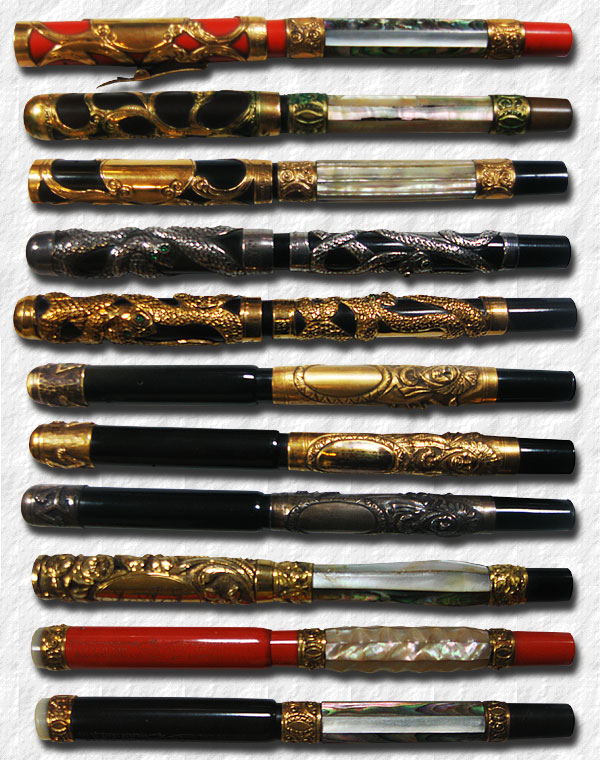
Parker models before the Duofold (a selection):
George S Parker pen mottled rubber (1889—1891) (Later became the Silver Dollar pen)
George S Parker pen Hexagon mottled rubber (1889—1894) (Later became the #8 pen)
Silver Dollar (aka Palmer Pen)(1891—1909)
Silver Dollar chased (aka Palmer Pen)(1891—1909)
Silver Dollar mottled (aka Palmer Pen)(1891—1909)
Shorthand Ladies (1899-1915)
Shorthand Gentlemens (1899-1915)
Dollar (1909—1910)
Special (1891—1899)
New Special (1900—1909)
College Pen (1891—1901)
Bulldog Special (1900 (UK), 1902 (US)—1907)
Mercur (1904)
Emblem (1906—1915)
The Wizard back ED screw joint (1891—1901)
Trench pen (1916—1918)
Bullet Parker Jack Knife Cartridge ring top (1918)
Transparent bakelite Jack Knife pen that was offered in the translucent colours o red, pink and green in three sizes.(1918)
Ivorine (1916—1925)
Red Giant (1909—1917)
Black Giant (1914—1921)
Baby turban top Jack Knife (1909—1914)
AX: Solid 14k gold floral engravings #4 nib (1910—1915)
BX: Solid 14k gold antique gold background effect with intertwined leaves and vines standing out in bas-relief. Studded with pearls, emeralds, rubies and other precious stones. (1910—1915)
CX: Solid 14k gold. Similar to the BX but with a pronounced floral design. (1910—1915)
DX: Solid 14k gold with a satin finish with ten small, sparkling diamonds at the center of the flowers. (1910—1915)
#020 Ladies sized Jointless pen in black or mottled rubber (1901—1915)
#020 Gentlemen's sized Jointless pen in black or mottled rubber (1899—1915)
#021 was also introduced in November with two ornamented cap bands (1900—1915)
#023 Jointless pen in black or mottled rubber (1899—1915)
#023 Jointless Hexagon with straight cap in black or mottled rubber (1902—1915)
#024 Jointless pen in black or mottled rubber (1899—1915)
#025 Jointless pen in black or mottled rubber (1899—1915)
#026 Jointless pen in black or mottled rubber (1900—1915)
#1 A plain Raven black pen in Black hard rubber or Red and Black mottled finish. (1893—1915)
#3 was of a similar design but sported a chased barrel. (1893—1915)
#3 The ladies sized pen sported three stars on the body and had a tapered cap. (1897—1915)
#3 As did the Regular but this had a chased body with lines running diagonally. A third version was chased in a diagonal pattern. (1897—1915)
#5 had a spiral body in Black or Mottled with a tapered cap. (1896—1915)
#5 also came in two designs, the previous Spiral and also an attractive diagonal Twist band version. Both pens could be furnished in Black or Mottled. (1897—1915)
#6 was a smaller, ladies sized pen with a twisted design and two ornamented gold bands featuring a tapered cap. (1898—1918)
#6 regular size version of the ladies pen with twisted design, two gold bands and tapered cap. (1897—1918)
#8 Hexagon pen in Black or Mottled with a tapered cap. (1893—1915)
#9 had a wavy chased body and two ornamented gold rings with a black cap. (1893—1918)
#9 A new zig zag pattern over a body of rope chase (1897—1910)
#10 Similar to the #5 but with rope chased diagonal bands on a Black or Mottled body (1897—1910)
#11 Featured a cable chased gold or silver overlay with a black, tapered cap. (1897—)
#11 in etched aluminium (aluminum in the US). Aluminium was considered a precious metal at this time. It had a black body with vines of metallic leaves and a tapered cap. (1897—)
#12 Full Pearl, was a very attractive pen with a mother of pearl body held down by two ornamented gold rings, and a black, tapered cap. (1896—)
#14 Sterling Silver filigree (1902—1917)
#14 Baby size Jack Knife Sterling Silver filigree (1910—
#14 S Jack Knife Short length Sterling Silver filigree with a ring top (1918—
#15, with a barrel fitted with plates of mother of pearl, held by two ornamented gold bands and a cap covered in gold filigree with a name plate (1905—1915)
#16 18k gold plate filigree (1902—1917)
#16 Baby size Jack Knife solid 18k gold plate filigree (1910—
#16 S Jack Knife Short length gold plated filigree with a ring top (1918—
#18 Plain underfeed pen in Raven Black or Mottled in Red and Black, new style section (1899—)
#18 Screw joint with or without level-lock clip (1913—
#18 ½ Chased screw joint with or without level-lock clip (1913—
#20 was a simpler underfeed pen in Raven Black or Mottled in Red and Black. (—1896)
#20 Click filler (1905—1913)
#20 in red rubber (1909—
#20 Jack Knife turban top (1909—1914)
#20 Full length (extra long) Jack Knife turban top (1912—1914)
#20 Screw joint with or without level-lock clip, Button filler (1913—
#20 Bakelite, Button Filler or Eyedropper with or without level-lock clips (1914—
#20 Jack Knife with one ornamented cap band, tuban top (1914)
#20 Jack Knife, Button filler (1915—
#20 Jack knife baby (1917—
#20 ½ (1906—
#20 ½ College pen with a coloured crown (1909—1915)
#20 ½ Chased screw joint with or without level-lock clip, Button filler (1913—
#20 ½ Jack Knife, Button filler (1915—
#20 ½ a chased barrelled pen with two ornamented gold bands. (1915—
#20 ½ Chased Jack knife baby (1917—
#20 S Jack Knife Plain black, short lenght barrel with a ring top mounted on a thick gold "cap" (1918—
#20 S Jack Knife Plain black, short lenght barrel with a ring top and a wide cap band (1918—
#21 a plain barrelled pen with two ornamented gold bands, eyedropper or Button Filler. (1905—
#21 ½ Chased with two ornamented gold bands, eyedropper or Button Filler. (1905—
#21 ½ College pen with a coloured crown (1909—1915)
#23 Click filler (1905—1913)
#23 in red rubber (1909—
#23 Jack Knife turban top (1909—1914)
#23 Screw joint with or without level-lock clip, Button filler (1913—
#23 Bakelite, Button Filler or Eyedropper with or without level-lock clips (1914—
#23 Jack Knife, Button filler (1915—
#23 Jack knife baby (1917—
#23 Level lock hexagon (1917
#23 ½ chased (1905—
#23 ½ Full length (extra long) Jack Knife turban top (1912—1914)
#23 ½ Chased screw joint with or without level-lock clip, Button filler (1913—
#23 ½ Jack Knife, Button filler (1915—
#23 ½ Chased Jack knife baby (1917—
#24 a plain underfeed pen in Raven Black or Mottled in Red and Black
#24 Falcon screw joint pen had a nib with a broad neck and a horseshoe-shaped depression for increased rigidity (1905—
#24 Click filler (1905—1913)
#24 in red rubber (1909—
#24 Jack Knife turban top (1909—1914)
#24 Click filler College pen with a coloured crown (1909—1913)
#24 Full length (extra long) Jack Knife turban top (1912—1914)
#24 Screw joint with or without level-lock clip, Button filler (1913—
#24 Bakelite, Button Filler or Eyedropper with or without level-lock clips (1914—
#24 Jack Knife, Button filler (1915—
#24 Jack knife baby (1917—
#24 ½ (1906—
#24 ½ Chased screw joint with or without level-lock clip, Button filler (1913—
#24 ½ Jack Knife, Button filler (1915—
#24 ½ Chased Jack knife baby (1917—
#25 a plain underfeed pen in Raven Black or Mottled in Red and Black
#25 Click filler (1905—1913)
#25 in red rubber (1909—
#25 Jack Knife turban top (1909—1914)
#25 Full length (extra long) Jack Knife turban top (1912—1914)
#25 Screw joint with or without level-lock clip, Button filler (1913—
#25 Bakelite, Button Filler or Eyedropper with or without level-lock clips (1914—
#25 Jack Knife, Button filler (1915—
#25 Jack knife baby (1917—
#25 ½ Chased (1906—
#25 ½ Chased screw joint with or without level-lock clip, Button filler (1913—
#25 ½ Jack Knife, Button filler (1915—
#25 ½ Chased Jack knife baby (1917—
#26 Screw Joint (1905—
#26 ½ Chased Screw Joint (1905—
#28 plain barrel Screw Joint (1905—
#28 Jack Knife (1917—
#28 1/2 Chased Screw Joint (1906—
#28 1/2 chased Jack Knife (1917—
#30 fully gold overlay (1900—1915)
#30 Sterling Silver overlay (1902—1915)
#31, was a large size pen with Sterling Silver leaf and vine filigree on both the cap and the barrel. (1906—1915)
#31 Had a very attractive spiral design, running the lenght of the cap and body. (1907—1915)
#32 it was similar to the #14 but with a more intricate filigree on the cap and barrel. It also had a name plate (1906—1915)
#32 S Jack Knife Sterling Silver similar to the #14 but with a more intricate filigree on the cap and barrel. (1918—)
#33 was a gold filigree pen with a filigree crown on the cap (1906—1918)
#34 Sterling Silver filigree pen with a filigree crown on the cap (1906—1918)
#35 It was a heavy 18k gold plated overlay pen with a floral design and a name plate two sizes (1906—1915)
#36 It was a Sterling Silver plated overlay pen with a floral design and a name plate two sizes (1906—1915)
#37 Sterling Silver Snake (1906—1915)
#38 Gold Snake (1906—1915)
#39 Forget me not with stones and pearls set in the center of the flowers (similar to #54) (1912—1915)
#40 pen with deeply engraved flowers, leaves and vines in solid 18k gold (1902—1915)
#41 was a large barrel pen covered with a Sterling Silver filigree similar to the smaller #14 (1907—1915)
#42 ½ Chased body and with a very broad engraved gold band around the body with a large name plate in the middle. It also had a heavy gold crown on the cap (1907—
#43 In a dull finish 18k plated gold overlay with a floral design (1907—1915)
#43 Sterling Silver overlay with a floral design (1907—1915)
#45 corrugated mother of pearl slabs, held down by two ornamented gold rings. It also had a cap crown in gold and mother of pearl. (1908—1915)
#45 There was also a version offered with abalone instead of mother of pearl, with a light green crown stone. (1908—1915)
#45 a corrugated pearl body with two engraved cap rings and a tapered cap with gold overlay with swirl engravings and a name plate (1909—1915)
#45 Jack Knife corrugated pearl body with two engraved cap rings, with a white or coloured crown stone (1914—1915)
#46 Mother of pearl with a chased body and a gold filled tapered cap (1910—1915)
#46 Mother of pearl and abalone with a chased body and a gold filled tapered cap (1910—1915)
#47 "Pregnant" with a body of mother of pearl and abalone, in a curved finish that created a bulge on the pen body, held down by two ornamented gold bands. The cap had an 18k gold overlay in a floral design with a name plate for engraving (1909—1915)
#48 plain barrelled pen with 14k gold overlay (1912—1915)
#48 (S) Jack Knife plain barrelled pen with 14k gold overlay (1912—
#49 plain barrelled pen with 14k gold overlay engraved with deep lines, two sizes (1912—1915)
#49 (S) Jack Knife plain barrelled pen with 14k gold overlay engraved with deep lines, two sizes (1912—1915)
#50 Plain with white and gold crown (1910—
#50 ½ Chased with white and gold crown (1914—
#51 Single gold ornament on the body with a name plate (1910—1917)
#51 S Jack Knife Single gold ornament on the body with a name plate (1918—)
#52 Sterling hammered silver in a Swastika design (1910—1915)
#53 Swastika 18k gold overlay with Swastika design (1910—1915)
#54 A heavy gold plate 18k overlay with forget-me-nots on a vine. (Similar to the #39) (1911—1915)
#55 Jack Knife plain barrelled pen with sterling silver overlay (1912—1915)
#56 Jack Knife plain barrelled pen with sterling silver engraved with deep lines, two sizes (1912—1915)
#57 Awanyu "Aztek" Sterling Silver half-overlay with cap crown (1911—1915)
#58 Awanyu "Aztek" gold filled half-overlay with cap crown in 18k gold (1911—191?)
#59 Awanyu "Aztek" full Sterling Silver overlay (1911—1915)
#60 Awanyu "Aztek" full gold filled overlay in 18k (1911—1915)
#61 Barrel, cap and section in plain 18k gold overlay (1914—1915)
#62 had the barrel, cap and section in 18k gold overlay but it had elaborate engravings of leaves and vines, with a name plate (1914—1915)
#63 was a gold filled with a little wreath in the center of the barrel as a name plate, and lines around the ends of the barrel and the cap. (1914—1915)
#64 was a pen with the barrel, cap and section in gold overlay with a checkered design, except the ends of the cap and barrel which were plain with lines around and a name plate on the barrel (1914—1915)
#65 L Jack Knife with a very broad gold band mounted on the body (1918—
#65 S Jack Knife with a very broad gold band mounted on the body (1918—
#65 ½ L Chased Jack Knife with a very wide gold band mounted on the body (1918—
#65 ½ S Chased Jack Knife with a very wide gold band mounted on the body (1918—
#66 L Jack Knife ring top mounted on a thick gold "cap" (1918—
#66 S Jack Knife ring top mounted on a thick gold "cap" (1918—
#66 ½ L Chased Jack Knife ring top mounted on a thick gold "cap" (1918—
#66 ½ S Chased Jack Knife ring top mounted on a thick gold "cap" (1918—
#70 was an 18 k overlay Jack Knife with a checkered design, a curious ball-ended collapsible pen with a ring top. (1916—
#71 ½ Baby transparent Bakelite, ring top (1918—
#72 ½ L Chased Jack Knife with a very wide gold band mounted on the cap (1918—
#72 ½ S Chased Jack Knife with a very wide gold band mounted on the cap (1918—
#73 ½ L Chased Jack Knife with two very wide gold bands mounted on the body and cap (1918—
#73 ½ S Chased Jack Knife with two very wide gold bands mounted on the body and cap (1918—
#74 ½ L Chased Jack Knife with a very wide gold band with "eye" ornamentation, mounted on the body (1918—
#74 ½ S Chased Jack Knife with a very wide gold band with "eye" ornamentation, mounted on the body (1918—
#75 ½ L Chased Jack Knife with a very wide gold band with ornamentation mounted on the cap (1918—
#75 ½ S Chased Jack Knife with a very wide gold band with ornamentation mounted on the cap (1918—
#76 L Jack Knife with a wide straight chased gold filled cap band (1918—
#76 S Jack Knife with a wide straight chased gold filled cap band (1918—
#81 Chased! broad body band (1922—
#82 Chased! broad body band ring top on a rope crown (1922—
#83 Chased! broad cap band ring top on a rope crown gold blind cap (1922—
#84 Chased! ring top on a rope crown gold blind cap (1922—
#90
#91
#92
#95 S Jack Knife Plain overlay Sterling Silver with a ring top on a rope-crown (1918—
#96 S Jack Knife Engraved overlay Sterling Silver with a ring top on a rope-crown (1918—
#98 S Jack Knife Plain overlay gold filled with a ring top on a rope-crown (1918—
#99 S Jack Knife Engraved overlay gold filled with a ring top on a rope-crown (1918—
#100 the Bookkeeper's Special. It was a very long pen with nibs and caps at both ends, one for black ink and one for red ink. The red ink barrel was made in mottled red and black while the black ink barrel was in black. They could also be taken apart to be used as two separate pens. (1907—1915)
#101
#106
#107
#140 in the same design as the #14 but larger and with a size #4 nib in Sterling Silver (1914—1915)
#160 in the same design as the #16 but larger and with a size #4 nib in Gold Filigree (1914—1915)
#201 Jack Knife engraved solid gold overlay eyedropper (1921—
#202
#203 Jack Knife engraved Sterling Silver overlay eyedropper (1921—
#204
#M-301 CM in brokade sterling (1918—)
#M-301 CM in Sterling silver (1918—)
#M-301 RM in Sterling silver (1918—)
#M-308
#M-309
#M-310
#M-401 RM in plain green gold (1918—)
#M-401 CM in plain green gold (1918—)
#M-403 CM i engine turned green gold (1918—)
#M-403 RM i engine turned green gold (1918—)
#M-405 CM i chased green gold (1918—)
#M-405 RM i chased green gold (1918—)
#M-412 CM
#M-412 RM
#M-501 CM in plain Yellow gold (1918—)
#M-501 RM in plain Yellow gold (1918—)
#M-502 CM
#M-502 RM
#M-504 CM in engine turned Yellow gold (1918—)
#M-504 RM in engine turned Yellow gold (1918—)
#M-511 CM in brokade Yellow gold (1918—)
#M-511 RM in brokade Yellow gold (1918—)